
Outcome verification guide
Duel Provably Fair 2026
 Available in US
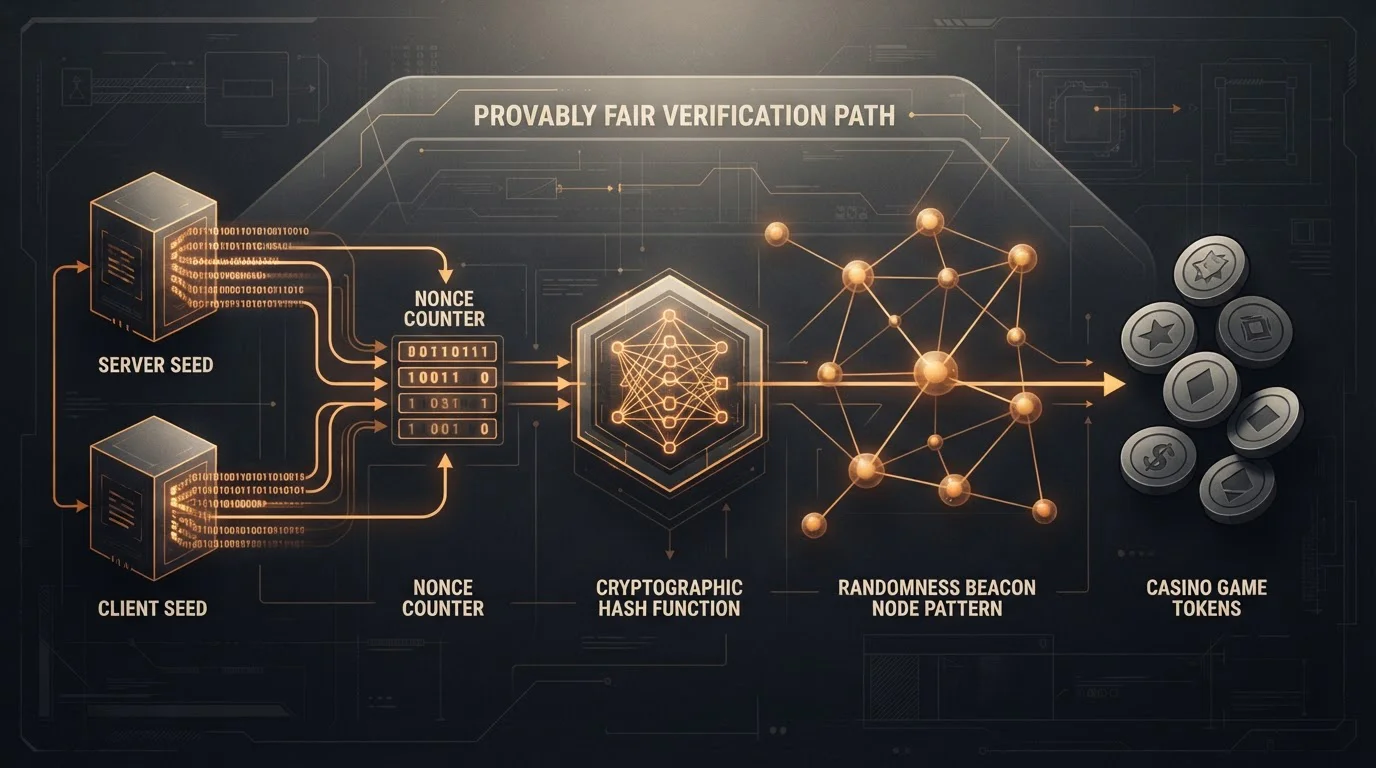
Duel Originals use a provably fair model built around a server seed, client seed, nonce and SHA-256. The point is narrow but useful: disclosed inputs can be used to check whether a recorded result follows the deterministic game logic. Multiplayer Crash adds a decentralized drand beacon to that verification stack.
- Game familyDuel Originals
- InputsServer seed + client seed + nonce
- Hash functionSHA-256
- Multiplayer Crashdrand beacon
Four components turn a game result into something you can reproduce
The Duel Originals fairness model is described with four core elements: a server seed, a client seed, a nonce and SHA-256. The design fixes the result before the wager and lets the player reproduce the outcome independently from the disclosed inputs.
The roles are easiest to understand separately. A server seed is the casino-side input. A client seed gives the player side of the calculation its own input. A nonce changes from one wager to the next so repeated games do not all resolve from the same exact input combination. SHA-256 is the cryptographic hash function used in the process.
This architecture belongs to the in-house Duel Originals line rather than to every third-party title in the broader casino library. A slot from an external provider may use its own certification and RNG model instead, so the presence of provably fair Originals should not be generalized to all 5,000+ games.
| Component | Role in the check | Practical reader question |
|---|---|---|
| Server seed | Casino-side input used by the deterministic result function | Is the relevant seed or commitment available for the round being checked? |
| Client seed | Player-side input combined with the server-side value | Does the verifier use the same client seed that applied to the wager? |
| Nonce | Separates successive wagers made with the same seed pair | Are you checking the exact nonce for the recorded bet? |
| SHA-256 | Cryptographic hash function used in the fairness process | Does the recomputed output match the game's recorded result path? |
| drand on multiplayer Crash | Adds a decentralized randomness beacon to that multiplayer format | Is the same drand value included when reproducing the Crash round? |
Verification is a reproduction exercise, not a trust slogan
A provably fair interface is useful because it lets a player move from “the casino says this was fair” to “these inputs produce this outcome.” In a typical provably fair design, a cryptographic commitment helps prevent the server-side value from being changed after the player has acted, while the revealed inputs let the result be recomputed later. Duel's implementation uses the seed pair, nonce and SHA-256 to make that reproduction possible.
The exact screen layout can change, but the reasoning stays stable: identify the round, collect the inputs attached to that round, apply the same algorithm, and compare the calculated result with the recorded one. A mismatch is the event that matters. A match means the disclosed inputs and deterministic rules are internally consistent for that wager.
- Open the history or fairness information for the exact Original wager you want to check.
- Record the server-side value made available for verification, the client seed and the nonce tied to that wager.
- For multiplayer Crash, include the drand beacon value used for the round.
- Run the same published calculation or verifier process that maps those inputs through SHA-256 to the game outcome.
- Compare the reproduced result with the result recorded in the game history.
A single successful check does not mean every past or future wager has been checked. It shows that the selected round can be reproduced from its disclosed inputs. Repeating the process across several wagers gives a better understanding of how the mechanism behaves.
Crash uses an extra decentralized randomness beacon
Duel's multiplayer Crash is described as using drand in addition to the seed-based fairness model. Drand is a decentralized randomness beacon: independent participants collectively produce public randomness that can be referenced by applications.
The reason an external beacon is useful in a multiplayer context is that many players share the same round. A public randomness input gives that shared event an additional value that does not come solely from one player's client seed or one casino-side seed.
This does not mean drand predicts when the Crash multiplier will stop. The beacon contributes an input to the deterministic process; once the required inputs are known, the historical round can be checked. Prediction and verification are different activities.
Shared round, shared reference
A multiplayer Crash result has to be common to all participants in the round, so a public beacon is a natural fit for the verification path.
Public randomness is not foreknowledge
The purpose is to support a checkable historical result, not to hand players a reliable way to forecast the next outcome.
The exact round still matters
Verification only works when the drand value, seeds and nonce all correspond to the same recorded event.
Provably fair proves a narrow property of the game outcome
The strongest interpretation is also the most limited one: a successful check shows that the disclosed inputs and deterministic rules reproduce the recorded outcome. That can expose after-the-fact manipulation of the inputs used by the verification scheme, but it does not answer every question a casino player might have.
It does not guarantee that you will win, that a volatile game will produce smooth results, or that a withdrawal will reach your wallet on a fixed schedule. Payment processing is a separate operational issue covered in the Duel withdrawals guide. It also does not replace the need to read game rules, because a result can be generated fairly under a paytable that still carries substantial variance.
What the check can establish
- The selected round can be recomputed from its disclosed inputs.
- The nonce and seed combination maps to the recorded game outcome under the published logic.
- Crash can incorporate the published drand value into a shared multiplayer round.
What stays outside the check
- Whether your next bet will win.
- Whether a short session will track theoretical RTP.
- How quickly a payment request will settle on a blockchain.
- Whether a chosen stake is suitable for your budget.
Fairness and RTP answer different mathematical questions
Duel advertises its Originals at 100% RTP, or 0% house edge, within stated wagering limits. That percentage describes product economics and still needs separate context from the fairness mechanism.
Provably fair does not establish RTP by itself. A game can be perfectly reproducible and still have a house edge if its paytable is designed that way. Conversely, a 100% theoretical RTP claim does not tell you whether the outcome generation process is independently checkable. One concerns expected value over many plays; the other concerns integrity of individual outcome generation.
The Originals guide covers the allowance of about $50,000 in daily wagering, the roughly $1,000 per-bet cap and the 5% wager-free Originals rakeback. Those figures belong beside the RTP discussion, not inside the cryptographic proof.
- Provably fair
- Can the selected historical result be reproduced from the disclosed inputs?
- RTP
- What does the game's long-run payout model imply over a very large number of wagers?
- Variance
- How widely can short-term results move around that long-run expectation?
- Rakeback
- What separate reward applies to wagering activity, independent of the game-result calculation?
A useful fairness check starts with the exact wager
The most common failure in any manual verification process is checking the wrong data. A careful routine keeps the round identity and each input together before doing any calculation.
- Match the wager history entry to the exact Original and round you are checking.
- Copy the client seed and nonce without changing formatting.
- Use the server-side value disclosed for that same verification cycle.
- Include the drand beacon when checking a multiplayer Crash round.
- Compare the recomputed output with the recorded result, not with what you hoped the result would be.
If a verifier offers both raw inputs and a human-readable outcome, keep both. The raw values are what make the process auditable; the readable result is what connects the calculation back to the game history.
Duel provably fair FAQ
Which Duel games use provably fair mechanics?
Duel's in-house Originals use the provably fair model described here. Do not assume the same mechanism applies to every third-party casino title; check the individual game's rules.
What inputs does Duel use for provably fair results?
The model uses a server seed, client seed and nonce with SHA-256. Multiplayer Crash additionally uses a decentralized drand beacon.
What does the nonce do?
The nonce distinguishes successive wagers made with the same seed pair, so each bet is checked against the correct position in the deterministic sequence.
Does provably fair mean I cannot lose?
No. It lets you check how an outcome was generated from the disclosed inputs. It does not remove variance or guarantee a winning session.
Does provably fair prove that withdrawals are fast?
No. Game-outcome verification and payment processing are separate systems. Withdrawal timing still depends on casino-side processing and blockchain settlement.
The value of Duel's fairness system is reproducibility, not prediction
Duel Originals expose a concrete fairness model built from server seed, client seed, nonce and SHA-256, with drand added to multiplayer Crash. That gives players a way to reproduce historical outcomes instead of relying only on a generic fairness claim. Its scope is deliberately narrow: it checks the integrity of game-result generation, while RTP, variance, wagering limits, account controls and withdrawals remain separate questions.