In-house game guide
Duel Originals 2026
 Available in US
Duel runs its own Originals line alongside third-party casino games. The useful distinction is not how many Originals exist at a given moment, because published counts differ, but how the in-house games combine named titles, provably fair mechanics, an advertised 100% RTP model within stated limits, and 5% wager-free rakeback.

- In-house lineDuel Originals
- Advertised model100% RTP / 0% edge within limits
- Allowance contextAbout $50,000 in daily wagering
- Per-bet contextAbout $1,000 per bet
- Rakeback5%, wager-free
The named lineup is broader than one game style
The named Duel Originals lineup includes Dice, Crash, Plinko, Mines, Blackjack, Beef, Keno, Video Poker, Castle Roulette, Rock Paper Scissors and Groomer's Van. Published totals differ, so the exact count is best left open rather than forcing one number onto a changing in-house catalogue.
The list shows why Originals deserve a separate page from the wider Duel games catalogue. Some names echo familiar casino formats, while others are clearly proprietary labels. That means a player should not assume that a Duel Original follows the same paytable, pace or decision structure as a third-party game with a similar name.
The practical comparison unit is the individual rules screen. “Blackjack” can sound familiar, for example, but an in-house implementation can still differ in deck model, payout rules or interaction flow. The same principle applies to roulette-like, dice-like and crash-style names: recognize the format, then read the actual rule set before staking.
Familiar names reduce the learning curve
Dice, Blackjack, Keno and Video Poker are recognizable categories, which helps a reader understand the broad shape of the game before opening it.
Proprietary names need a rules-first approach
Titles such as Beef or Groomer's Van should be treated as their own products. The name alone does not establish the payout structure or risk profile.
Catalogue count is secondary
Published totals differ, so the stable facts are the existence of the Originals studio, its named titles and the mechanics attached to individual games.
| Originals detail | What it tells you | What to check before playing |
|---|---|---|
| Dice, Crash, Plinko, Mines, Blackjack, Keno, Video Poker | The in-house line covers several recognizable casino and probability-game formats | The exact rules, payout mapping and any game-specific limits |
| Castle Roulette, Rock Paper Scissors | Duel also uses familiar concepts in proprietary implementations | How outcomes are mapped to payouts rather than assuming standard casino rules |
| Beef, Groomer's Van | The catalogue includes titles whose economics cannot be inferred from the name | The full information panel, settlement logic and fairness check |
| Conflicting published Originals totals | The lineup has been described differently across sources | Use the current lobby for the live catalogue rather than relying on one historical count |
The 100% RTP claim is a product condition, not a session guarantee
Duel advertises its Originals as operating at 100% RTP, or 0% house edge, within the product's daily wagering allowance. Other coverage places the range at 99–100%, so 100% is best read as Duel's advertised model rather than as a universal numerical promise for every possible state or session.
RTP is a long-run expectation. Even a game with a theoretical 100% return can produce large short-term swings because individual outcomes vary. A player can lose a sequence of bets, win a sequence, or finish far from the theoretical average over a small sample. “Zero edge” therefore does not mean “no risk,” and it does not remove variance.
This is one reason the provably fair mechanics deserve separate attention. Fairness verification can help check whether the disclosed inputs reproduce a game result, while RTP describes the long-run mathematics of the rule set. They answer different questions and should not be merged into one trust claim.
- Advertised 100% RTP
- A long-run return model Duel attaches to Originals within its stated limits.
- 0% house edge
- Another way of expressing a theoretical 100% RTP condition, not a promise that every player breaks even.
- Variance
- The reason short sessions can finish far above or below the long-run expectation.
- Provably fair
- A verification mechanism for game outcomes, separate from RTP and session profitability.
The allowance and per-bet cap define where the advertised model applies
The same product framework is described with an allowance of about $50,000 in aggregate daily wagering and a cap of about $1,000 per bet. Those figures matter because they put a boundary around the 100% RTP positioning rather than presenting it as an unlimited economic condition.
Two different limits are involved. A per-bet cap constrains the size of an individual wager, while a daily allowance constrains aggregate wagering over a longer period. A player can therefore remain below the per-bet figure and still reach the broader daily allowance through repeated play.
The consequence is practical: anyone comparing the advertised 0% edge with a conventional game should check where they are relative to both limits. The marketing headline is incomplete without the operational boundary attached to it.
Read the two controls separately
- About $1,000 per bet is the single-wager cap described for the framework.
- About $50,000 is the aggregate daily wagering allowance described for the framework.
- Both figures belong to the advertised 0%-edge framework rather than to a guarantee of winnings.
Do not treat limits as a risk budget
- A permitted stake can still be too large for an individual bankroll.
- Repeated bets can compound variance even when each bet is below the cap.
- Theoretical edge and personal loss tolerance are different questions.
Originals use the lowest of Duel's three published rakeback rates
Duel lists 5% wager-free rakeback for Originals, compared with 50% on slots and 80% on Duel Blackjack. The category difference matters: using the slot rate or blackjack rate for an Original would overstate the reward layer.
Rakeback is separate from game RTP. One describes a reward tied to wagering activity; the other describes the long-run game mathematics. The Duel bonus and rewards guide explains the broader model, including the absence of a traditional welcome bonus and the way Duel emphasizes rakeback instead.
Because the Originals RTP positioning is already unusual, it is especially important not to combine the 5% reward with the advertised 100% RTP into a simplistic “105% return” claim. Timing, eligibility, variance and the boundaries of the 0%-edge allowance make that arithmetic misleading as a prediction of what a player will receive.
Provably fair mechanics let the result be checked independently
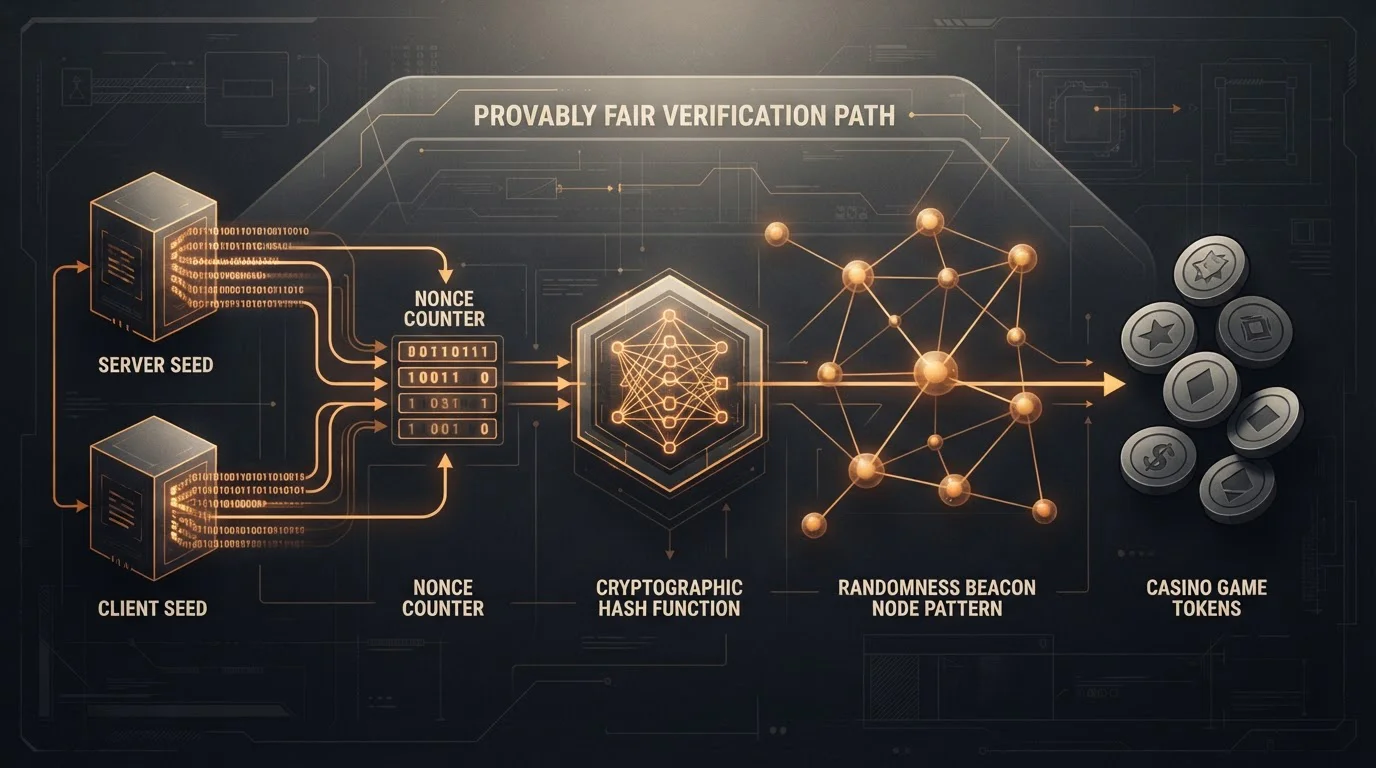
Duel Originals use a provably fair system built around a server seed, client seed, nonce and SHA-256. The design fixes the result before the wager and allows the outcome to be checked independently from those inputs. Multiplayer Crash adds a decentralized drand beacon to the process.
That is more useful than a generic “fair game” label because it gives the player something concrete to inspect. A deterministic verification step can show whether the same disclosed inputs reproduce the recorded outcome. The dedicated Duel provably fair guide walks through the components and the limits of that check.
Provably fair does not eliminate normal gambling risk. It does not promise a favorable sequence, reduce volatility or establish that a payout request will be processed in a particular time. It is a narrow integrity tool for game outcomes.
A six-step routine keeps the headline claims in context
The Originals proposition is easiest to evaluate when the game rules, economic limits and verification layer are handled one by one.
- Open the exact Original you want to play and read its rules rather than inferring mechanics from the title.
- Check the displayed payout logic and any game-specific limits before choosing a stake.
- Treat the advertised 100% RTP / 0% edge as a long-run product condition, not a session forecast.
- Keep the per-bet cap and daily wagering allowance in view when interpreting that positioning.
- Apply the 5% Originals rakeback rate separately from the game's own mathematics.
- Use the provably fair inputs to check outcomes where the verification interface makes them available.
Players looking for a more conventional catalogue comparison can move back to Duel slots, where the relevant variables are provider, title-specific RTP, volatility and a different rakeback rate.
Duel Originals FAQ
How many Duel Originals are there?
Published sources give different totals, so there is no single stable number to use. A detailed review names Dice, Crash, Plinko, Mines, Blackjack, Beef, Keno, Video Poker, Castle Roulette, Rock Paper Scissors and Groomer's Van.
Do Duel Originals really have 100% RTP?
Duel advertises 100% RTP, or 0% house edge, for Originals within its stated wagering allowance. Some coverage describes the range as 99–100%, so 100% is best treated as Duel's advertised model rather than a guaranteed personal return.
What limits apply to the 0% edge Originals model?
The 0%-edge framework is described with about $50,000 in aggregate daily wagering and about $1,000 per bet.
What rakeback applies to Duel Originals?
Duel lists 5% wager-free rakeback for Originals. Slots and Duel Blackjack have different published rates.
Are Duel Originals provably fair?
Yes. The Originals system uses a server seed, client seed, nonce and SHA-256 for independently checkable outcomes; multiplayer Crash also uses a drand beacon.
The strongest case for Originals is transparent mechanics, not a promise of profit
Duel's in-house line combines a named set of games, a provably fair verification model, 5% wager-free rakeback and an advertised 100% RTP / 0% edge framework bounded by daily and per-bet limits. That combination is distinctive, but it still leaves normal gambling variance intact. The useful evaluation is therefore mechanical: read the rules, understand the limits, separate rakeback from RTP, and verify the outcome rather than treating the headline percentage as a personal return guarantee.